
Have you noticed small red or purple spots appearing on your skin as you’ve got older?
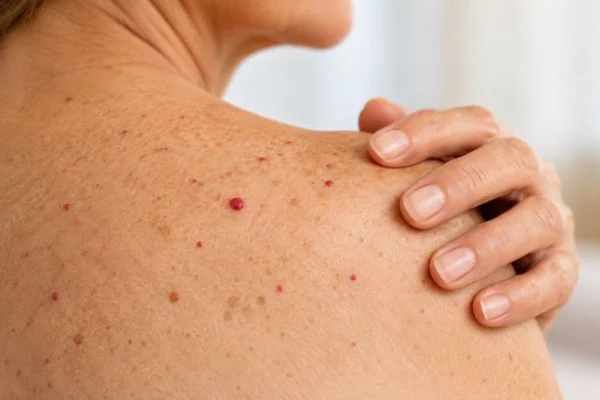
These may be cherry angiomas, also known as Campbell de Morgan spots. They are common benign vascular skin growths and often become more noticeable or numerous with age.
Although cherry angiomas are generally harmless, suddenly noticing new marks on your skin can understandably raise questions.
So why do cherry angiomas become more common as we get older, what are they actually made of, and when should you have a skin lesion checked?
What Are Cherry Angiomas?
Cherry angiomas are small vascular skin growths made up of blood vessels.
They often appear as small, round spots that can range from bright red to darker red or purple. Some are relatively flat, while others become slightly raised.
They can occur on different areas of the body but are particularly common on the torso.
You may have just one cherry angioma or develop multiple lesions over time.
Are Cherry Angiomas More Common With Age?
Yes. Cherry angiomas can occur in younger adults, but they become considerably more common with increasing age.
Dermatology sources report that their numbers tend to increase around age 40, with cherry angiomas being extremely common among older adults.
However, getting older doesn’t fully explain why they develop.
Why Do Cherry Angiomas Develop As We Get Older?
The cause of cherry angiomas isn’t fully known. Researchers know they involve a proliferation of small blood vessels in the skin and that their frequency tends to increase with age. Still, no single established cause explains why an individual develops them.
Several factors have been investigated.
Ageing
Age is one of the clearest associations.
As the years pass, you may gradually notice more cherry angiomas appearing. This doesn’t necessarily mean there is something wrong with your skin.
Rather than saying ageing directly causes cherry angiomas, it is more accurate to say they become increasingly common with age.
Genetics
Genetics may also play a role.
Some people seem more prone to developing cherry angiomas than others, and they may notice that other family members have similar red skin lesions.
Research has also identified certain genetic mutations within some cherry angiomas, although research into precisely why these lesions develop continues.
Hormonal and Other Factors
Cherry angiomas have also been reported in association with pregnancy and several other circumstances.
However, associations don’t necessarily prove that a particular factor caused the angioma.
If you suddenly develop many new skin lesions or experience other unexplained symptoms, it’s sensible to speak to an appropriate healthcare professional rather than trying to determine the cause yourself.
Are Cherry Angiomas Dangerous?
Typical cherry angiomas are benign, meaning they are non-cancerous.
In most cases, they don’t require treatment.
The key is making sure a mark you believe is a cherry angioma really is a benign lesion.
Different skin lesions can sometimes look similar. You shouldn’t assume every red, purple, or dark skin growth is a cherry angioma just because it looks similar to pictures online.
When Should You Have a Skin Lesion Checked?
Seek appropriate medical advice if you have a skin lesion that:
- is new or changing
- changes noticeably in size, shape or colour
- regularly bleeds without an obvious reason
- becomes persistently itchy or painful
- looks noticeably different from your other skin lesions
- has an unusual appearance
- or you aren’t sure what it is.
A GP or other healthcare professional can assess a lesion and advise whether further investigation is needed.
This is particularly important before considering cosmetic removal of a lesion whose identity is uncertain.
Do Cherry Angiomas Need to Be Removed?
Usually, no.
If a cherry angioma has been identified as benign and isn’t bothering you, there is generally no medical reason to remove it.
Some people still choose cosmetic removal because the lesion is visible or repeatedly catches on clothing or jewellery.
Consider treatment only when the lesion is suitable and its identity is certain.
Can Cherry Angiomas Be Treated With Cryotherapy?
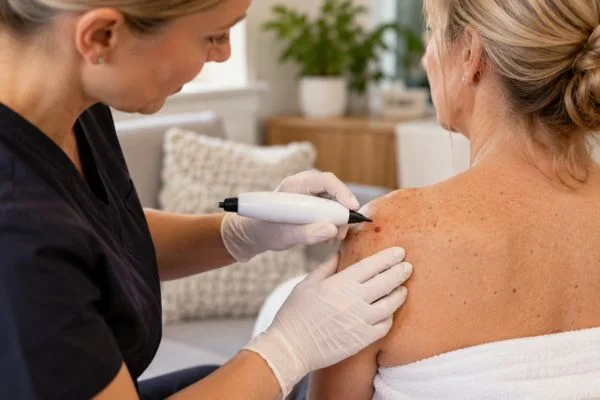
Cryotherapy is one method that may be used for suitable cherry angiomas.
Cryosonic offers CryoPen treatment for a range of suitable benign skin lesions, including cherry angiomas.
CryoPen delivers a focused application of nitrous oxide to the targeted area. Suitability should always be considered individually, and treatment results can vary.
Importantly, cosmetic lesion treatment isn’t a substitute for medical diagnosis.
If you’re unsure about a lesion, or it shows concerning or unexplained changes, a medical assessment may be recommended before considering cosmetic treatment.
Will Removing Cherry Angiomas Stop New Ones Appearing?
No treatment can guarantee that you won’t develop other cherry angiomas elsewhere in the future.
Removing an existing suitable lesion addresses that particular lesion; it doesn’t change your underlying tendency to develop new cherry angiomas as you get older.
This distinction matters if you’ve noticed several appearing over the years.
Can You Prevent Cherry Angiomas?
Because the precise cause of cherry angiomas isn’t fully understood, there’s no proven way to prevent them.
You may see claims online suggesting that particular diets, supplements, skincare products or home remedies can prevent or remove cherry angiomas. Be cautious with these claims.
You should also avoid attempting to cut, burn, freeze or otherwise remove an unidentified skin lesion yourself. Doing so could cause bleeding, skin damage or infection and, importantly, could delay appropriate assessment of a lesion that isn’t actually a cherry angioma.
Cherry Angiomas and Ageing: The Bottom Line
Cherry angiomas are extremely common benign vascular skin growths, and the likelihood of developing them increases with age.
Scientists don’t yet have one definitive explanation for why they develop. Ageing and genetic factors appear to play a role, but having cherry angiomas doesn’t usually indicate a health problem.
If you already have a lesion that has been appropriately identified as a cherry angioma and would like to discuss cosmetic removal, Cryosonic can advise whether CryoPen treatment may be suitable.
If a lesion is new, changing, unusual or hasn’t been appropriately assessed, seek advice from an appropriate healthcare professional before considering cosmetic removal.
Frequently Asked Questions About Cherry Angiomas
At what age do cherry angiomas start appearing?
They can occur in younger people, but cherry angiomas become increasingly common during adulthood, and their numbers often increase with age.
Why am I suddenly getting more cherry angiomas?
The number of cherry angiomas often increases with age. However, if you experience a sudden or unusual eruption of numerous lesions, particularly alongside other unexplained symptoms, consider seeking medical advice.
Are cherry angiomas cancerous?
Typical cherry angiomas are benign, non-cancerous vascular growths. However, don’t self-diagnose an unusual skin lesion based solely on its appearance. New, changing or concerning lesions should be appropriately assessed.
Should I worry if a cherry angioma bleeds?
A raised angioma can bleed if it is scratched or traumatised. However, a lesion that repeatedly or spontaneously bleeds, changes or causes concern should be assessed by an appropriate healthcare professional.
Can cherry angiomas disappear naturally?
Cherry angiomas generally tend to persist once they have developed rather than routinely disappearing by themselves.
Can CryoPen remove cherry angiomas?
Cryotherapy may be used for suitable cherry angiomas. At Cryosonic, we assess suitability before treatment. Results vary, and not every skin lesion is appropriate for cosmetic treatment.
Can new cherry angiomas appear after treatment?
Yes. Treating an existing cherry angioma doesn’t prevent new ones from developing elsewhere on the skin in the future.
Should I remove cherry angiomas at home?
No. Avoid cutting, burning or attempting to freeze an unidentified skin lesion yourself. A professional assessment is important to determine whether cosmetic treatment is appropriate.
Speak to Cryosonic
If you have a previously assessed or clearly identified cherry angioma that you would like to have removed for cosmetic reasons, speak to the Cryosonic team about whether CryoPen treatment may be suitable for you.
Treatment is subject to suitability and individual assessment. Results vary, and cosmetic treatment should not replace medical assessment or diagnosis of an uncertain, new, or changing skin lesion.